






ByteDance’s Gauth takes AI Course global with 200+ math lessons and student-built courses
Gauth, the overseas education app operated by ByteDance, has fully launched its AI Course feature, adding more than 200 mathematics courses and opening the product to user-generated lessons, the company announced on 1 September 2026.
The rollout, timed to back-to-school season, follows a limited July debut that introduced cinematic history lessons. The new math library covers Algebra 1, Algebra 2 and Geometry — core US high school requirements — and Gauth says it spans every US high school math topic from Algebra I through AP Calculus.
Gauth says mathematics is its most-requested subject worldwide, accounting for 40.52% of student queries in the United States and 42.71% globally, with algebra alone making up roughly two-thirds of those requests. The courses are organised systematically: each subject is split into units, each unit into topics, and every unit displays its learning content and objectives so that progress and pathway stay visible.
Inside a lesson, the page is divided into four zones: a progress indicator at the top, an explanation area in the middle, synchronised text on the left, and an entry point to the AI tutor at the lower left. Where history lessons unfold as immersive, story-driven scenes, math lessons aim to make abstract concepts concrete — breaking ideas into visual images, explaining them through worked examples and analogies, then reinforcing recall with mind maps and varied quizzes. Students can pause at any point to question the AI tutor without losing their place.
The other half of the launch is creation. Gauth now lets users turn any topic into an AI interactive course: they enter a subject, select their current proficiency level and the specific area they want to cover, and the app builds a course in roughly three to five minutes, complete with AI narration, video, quizzes and tutoring. Finished courses can be shared with classmates. For now the generator produces “Tutor-Guided Lessons”; an “Immersive Experience Lesson” format is planned.
Research cited by the company suggests around 60% of students prefer visual learning, a share that rises in STEM fields. Emily Peraza, a college senior, used AI Course to master the Krebs cycle for the MCAT. “I’m a really visual learner, so a wall of text on something abstract is hard for me to hold onto,” she said. “The thing I could never get was a way to actually watch the pathway unfold at the level I needed.”
Traditional course production starts by forecasting demand, then has teachers or creators choose a topic, write materials and record video. That works well when large numbers of learners want the same thing, but breaks down when demand is highly specific — the gap Gauth is targeting. The approach also places a burden on students, who must know what they have mastered and where the gaps are, since vague requests produce vague courses. “At Gauth, we know learning isn’t a one-size-fits-all experience, so instead of asking millions of learners to fit into the same course, AI Course lets each student generate one designed specifically for them,” said Alan Wang, chief technology officer at Gauth. “It’s a new model that shifts students from consuming education to creating a learning experience that matches their own curiosity, skill level and goals.”
Gauth is not alone. VideoTutor’s AI teaching agent turns any study question into a personalised explainer video; Gemini recently added Study Notebooks, which builds short courses from uploaded materials; and Google’s NotebookLM turns documents into narrated video overviews. Launched in 2020 as Gauthmath, Gauth has surpassed 200 million downloads and is now pushing beyond its origins as a photo-based problem solver toward an all-in-one study platform.
The rollout, timed to back-to-school season, follows a limited July debut that introduced cinematic history lessons. The new math library covers Algebra 1, Algebra 2 and Geometry — core US high school requirements — and Gauth says it spans every US high school math topic from Algebra I through AP Calculus.
Gauth says mathematics is its most-requested subject worldwide, accounting for 40.52% of student queries in the United States and 42.71% globally, with algebra alone making up roughly two-thirds of those requests. The courses are organised systematically: each subject is split into units, each unit into topics, and every unit displays its learning content and objectives so that progress and pathway stay visible.
Inside a lesson, the page is divided into four zones: a progress indicator at the top, an explanation area in the middle, synchronised text on the left, and an entry point to the AI tutor at the lower left. Where history lessons unfold as immersive, story-driven scenes, math lessons aim to make abstract concepts concrete — breaking ideas into visual images, explaining them through worked examples and analogies, then reinforcing recall with mind maps and varied quizzes. Students can pause at any point to question the AI tutor without losing their place.
The other half of the launch is creation. Gauth now lets users turn any topic into an AI interactive course: they enter a subject, select their current proficiency level and the specific area they want to cover, and the app builds a course in roughly three to five minutes, complete with AI narration, video, quizzes and tutoring. Finished courses can be shared with classmates. For now the generator produces “Tutor-Guided Lessons”; an “Immersive Experience Lesson” format is planned.
Research cited by the company suggests around 60% of students prefer visual learning, a share that rises in STEM fields. Emily Peraza, a college senior, used AI Course to master the Krebs cycle for the MCAT. “I’m a really visual learner, so a wall of text on something abstract is hard for me to hold onto,” she said. “The thing I could never get was a way to actually watch the pathway unfold at the level I needed.”
Traditional course production starts by forecasting demand, then has teachers or creators choose a topic, write materials and record video. That works well when large numbers of learners want the same thing, but breaks down when demand is highly specific — the gap Gauth is targeting. The approach also places a burden on students, who must know what they have mastered and where the gaps are, since vague requests produce vague courses. “At Gauth, we know learning isn’t a one-size-fits-all experience, so instead of asking millions of learners to fit into the same course, AI Course lets each student generate one designed specifically for them,” said Alan Wang, chief technology officer at Gauth. “It’s a new model that shifts students from consuming education to creating a learning experience that matches their own curiosity, skill level and goals.”
Gauth is not alone. VideoTutor’s AI teaching agent turns any study question into a personalised explainer video; Gemini recently added Study Notebooks, which builds short courses from uploaded materials; and Google’s NotebookLM turns documents into narrated video overviews. Launched in 2020 as Gauthmath, Gauth has surpassed 200 million downloads and is now pushing beyond its origins as a photo-based problem solver toward an all-in-one study platform.




Related Articles
 DingTalk launches A1 Education Edition, an AI recorder that turns lessons into notes, quizzes and feedback
 17EdTech posts first quarterly profit as Q2 revenue jumps 254.6% on AI learning services
 iFlytek upgrades Xingguang 2.0, a teacher super-agent built to run the whole teaching chain
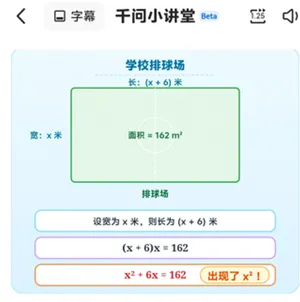 Qwen retools its learning features to teach the why, not just the answer
JMDedu is a leading B2B EdTech Media in China that informs and connects business professionals through our reports, events, and information services. Our mission is to drive the advancement of education. Our network spans the education industry in China as well as globally, including entrepreneurs, investors, startups, educators, business decision-makers, and policy decision-makers.

Copyright © 2014-2026 en.jmdedu.com All Rights Reserved